Every spring, Central DuPage homeowners watch helplessly as another set of patio shades tears loose from their deck railings. The strong prairie winds that sweep across DuPage County from the open farmland west of Lombard and Villa Park create unique challenges that generic outdoor shade products simply cannot handle. If you have spent money replacing flimsy roll-up shades after every major storm system that barrels through from Hidden Lake Forest Preserve toward Elmhurst, you already understand this frustration firsthand.
Unlike indoor window treatments that enjoy the protection of your home’s walls, wind resistant outdoor shades in Central DuPage must withstand sustained gusts averaging 15-20 mph during spring months, with peak gusts exceeding 45 mph during severe weather events (Source: National Weather Service Chicago, 2023). Your multi-level deck in Downers Grove or wraparound porch in Villa Park deserves shade solutions engineered specifically for these conditions.
Why Central DuPage Decks Face Unique Wind Challenges
The geography of DuPage County creates a perfect wind tunnel effect. With relatively flat terrain stretching from Aurora through to the western Chicago suburbs, there are few natural windbreaks to slow prevailing westerly winds before they reach your outdoor living space. Homeowners near Churchill Woods and other forest preserve areas often assume the trees provide protection, but the corridor effect between wooded areas actually accelerates wind speeds across residential neighborhoods.
The Multi-Level Deck Problem
Established Central DuPage neighborhoods in Downers Grove, Lombard, and Elmhurst feature homes built predominantly between 1960-1990, when multi-level decks and wraparound porches became architectural staples. These elevated outdoor spaces sit 8-15 feet above grade level, placing them directly in the path of unobstructed wind flow. Standard outdoor shades rated for ground-level patios fail catastrophically when installed at these heights.
The wind load on a shade installed on a second-story deck increases exponentially compared to ground level. According to the American Society of Civil Engineers, wind pressure at 15 feet elevation is approximately 28% higher than at 5 feet (Source: ASCE 7-22 Minimum Design Loads, 2022). Your deck shades in DuPage must account for this increased stress on mounting hardware, fabric tension systems, and frame components.
Seasonal Wind Patterns You Cannot Ignore
Central DuPage experiences distinct seasonal wind patterns that affect your outdoor shade investment:
- Spring (March-May): Peak wind season with average speeds of 12.3 mph and frequent gusts exceeding 35 mph during storm fronts (Source: Illinois State Climatologist Office, 2023)
- Summer (June-August): Calmer conditions averaging 8.5 mph, but severe thunderstorm downbursts can produce 60+ mph gusts with minimal warning
- Fall (September-November): Increasing wind activity as cold fronts return, averaging 10.8 mph with sustained periods of 20+ mph winds
- Winter (December-February): Bitter winds averaging 11.2 mph make outdoor spaces unusable regardless of shade presence
What Makes Outdoor Shades Truly Wind Resistant
The term windproof patio blinds Illinois gets thrown around loosely by manufacturers, but genuine wind resistance requires specific engineering elements that most budget products lack entirely. When evaluating porch sun protection for your Central DuPage home, examine these critical components:
Track-Guided Systems vs. Cable Systems
Traditional outdoor shades use simple top-mount rollers with weighted hems, relying on gravity alone to keep fabric in place. In Central DuPage wind conditions, these designs flutter, billow, and eventually detach from mounting points. True wind-resistant designs incorporate side-channel tracks or tensioned cable guides that secure the fabric along its entire vertical edge.
Track-guided systems maintain fabric position in winds up to 75 mph when properly installed (Source: Exterior Shade Manufacturers Association, 2022). Cable-guided alternatives handle approximately 45 mph before fabric displacement occurs, making them suitable for partially protected locations but inadequate for exposed upper decks throughout Villa Park and Lombard.
Fabric Weight and Weave Specifications
Not all shade fabrics perform equally in wind. The specifications that matter most for Central DuPage installations include:
| Specification | Minimum for Wind Resistance | Recommended for DuPage |
|---|---|---|
| Fabric Weight | 8 oz per square yard | 10-12 oz per square yard |
| Tear Strength | 35 lbs | 50+ lbs |
| Wind Load Rating | 35 mph sustained | 55+ mph sustained |
| UV Blockage | 70% | 90-97% for sun protection |
Mounting Hardware That Actually Holds
The failure point for most outdoor shade installations is not the fabric but the mounting hardware. Standard residential brackets designed for interior blinds cannot withstand the lateral forces generated by wind against large fabric surfaces. A 6-foot by 8-foot shade in 40 mph wind experiences approximately 192 pounds of lateral force (Source: Engineering Toolbox Wind Load Calculator, 2023).
For your deck shades in DuPage, insist on:
- Stainless steel or powder-coated aluminum brackets rated for exterior use
- Lag bolt or through-bolt mounting into structural framing, never just deck boards
- Minimum three mounting points per vertical edge on shades exceeding 6 feet tall
- Anti-vibration bushings that prevent hardware loosening from repeated wind stress
Installation Considerations for Central DuPage Homes
Your home’s architectural characteristics directly influence which wind-resistant solutions will perform best. The established neighborhoods throughout Central DuPage present specific installation scenarios that require local expertise to navigate successfully.
Deck Railing Mounts vs. Structural Mounts
Many homeowners in Elmhurst and Downers Grove assume their deck railings provide adequate mounting points for outdoor shades. However, most residential deck railings are designed to withstand only 200 pounds of lateral force per linear foot (Source: International Residential Code Section R507.4, 2021). A large shade catching wind can exceed this limit during sustained gusts, potentially damaging your railing system.
Structural mounts attached directly to your home’s exterior wall framing or deck ledger board provide significantly stronger anchor points. This installation approach also avoids warranty issues with composite decking manufacturers who void coverage when railings are modified.
Electrical Considerations for Motorized Options
Motorized shade systems offer convenience and can retract automatically when wind sensors detect dangerous conditions. If you are considering motorized porch sun protection for your Central DuPage home, verify that your outdoor electrical infrastructure supports the additional load. Most homes in Lombard and Villa Park built before 1985 have outdoor circuits rated at only 15 amps, which may require upgrading to accommodate motorized shades alongside existing deck lighting and outlet usage.
Your ComEd service panel should be evaluated by a licensed electrician before committing to motorized systems. Many older Central DuPage homes have 100-amp main panels that struggle to accommodate modern outdoor living electrical demands without service upgrades.
Permit Requirements in DuPage County
Depending on your specific municipality, permanent outdoor shade structures may require building permits. Downers Grove requires permits for shade structures exceeding 120 square feet. Lombard permits officer review is required for any shade structure attached to the primary residence. Villa Park and Elmhurst have similar requirements with slight variations in threshold sizes.
Proper permitting protects your investment by ensuring installations meet local wind load requirements. Unpermitted structures discovered during home sales frequently require costly removal or retrofitting that far exceeds original permit fees.
Selecting the Right Solution for Your Outdoor Space
With multiple product categories claiming wind resistance, understanding which type suits your specific Central DuPage application helps avoid expensive mistakes.
Exterior Solar Shades
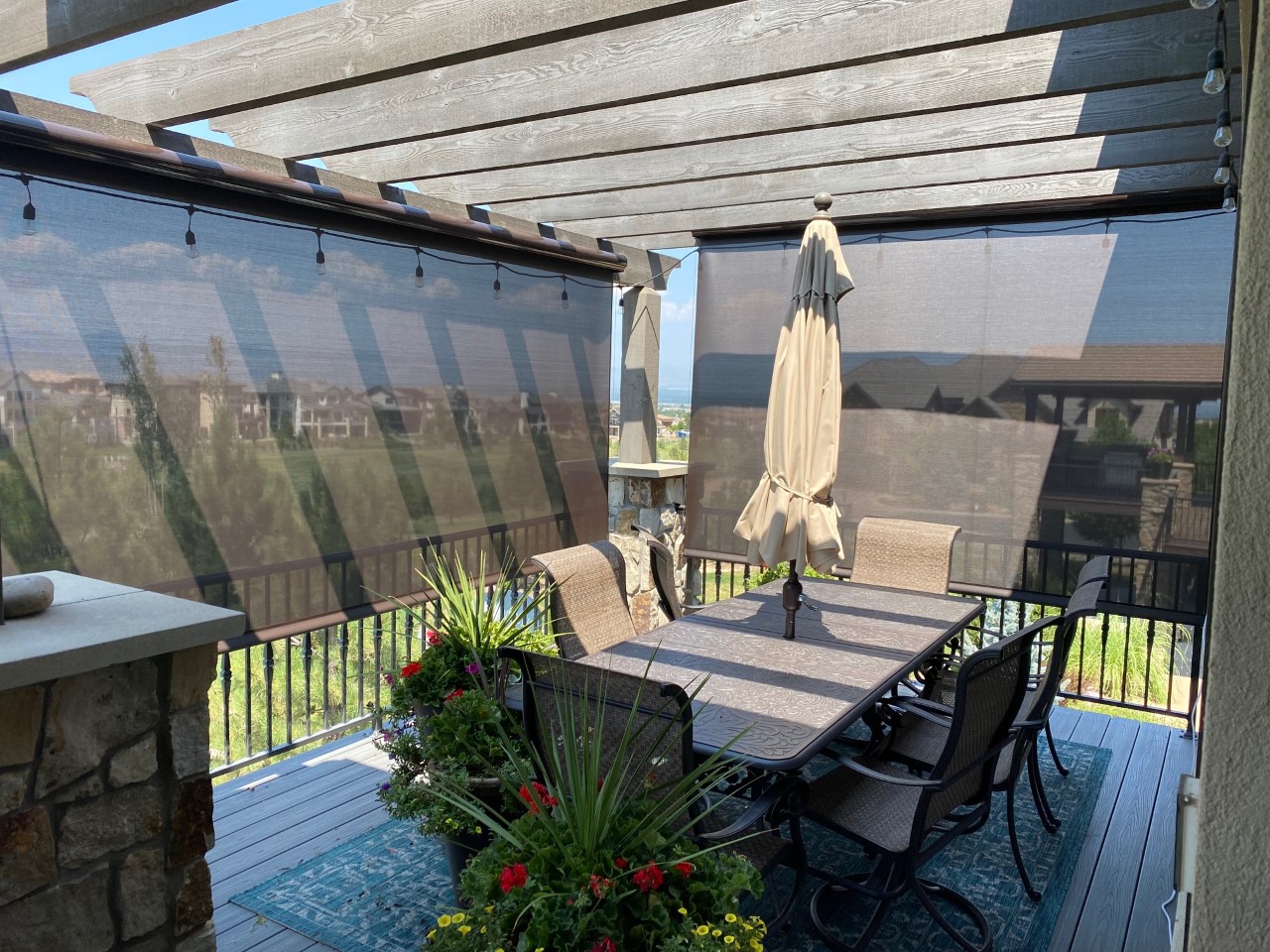
These mesh fabric systems block 80-97% of UV radiation while maintaining outward visibility. For decks overlooking Hidden Lake Forest Preserve or other scenic areas, solar shades let you enjoy the view while reducing solar heat gain by up to 65% (Source: ENERGY STAR Exterior Shading Systems Guide, 2023). When specified with track-guided systems, they perform well in winds up to 55 mph.
Retractable Screens
Full-enclosure retractable screen systems transform your porch or deck into a three-season room. Higher-end models feature automatic wind sensors that retract screens when wind speeds exceed safe thresholds, preventing damage during sudden storms common during Central DuPage summer months.
Pergola-Mounted Canopy Systems
If your deck features a pergola structure, canopy systems that attach directly to the pergola framework provide excellent wind resistance because the supporting structure absorbs wind loads rather than mounting brackets alone. These systems work particularly well on the wraparound porches common throughout older Elmhurst and Downers Grove neighborhoods.
Cost Expectations and Long-Term Value
Budget-focused homeowners often gravitate toward inexpensive outdoor shade products from home improvement stores, replacing them every 2-3 years after wind damage. This approach actually costs more over a 10-year period than investing in properly engineered wind-resistant systems from the start.
A quality track-guided exterior shade system for a typical Central DuPage deck (8×10 feet) ranges from $1,200-$3,500 installed, depending on fabric selection and motorization options. Budget alternatives averaging $200-$400 require replacement approximately every 2.5 years in local wind conditions, totaling $800-$1,600 over a decade plus significant installation hassle.
Additionally, properly installed exterior shading reduces cooling costs by 15-25% during summer months (Source: U.S. Department of Energy, 2023). For Central DuPage homeowners with average summer ComEd bills of $180-$250, this translates to $27-$63 monthly savings during June through August, partially offsetting higher initial investment.
Why Local Expertise Matters
National shade companies and online retailers cannot evaluate your specific wind exposure, deck construction, and architectural characteristics the way local professionals can. A shade system that performs perfectly on a ground-level patio in Phoenix will fail spectacularly on an elevated deck near Churchill Woods during your first Central DuPage spring storm season.
Local installers understand which products have proven track records in DuPage County conditions, which mounting approaches work best with regional construction methods, and how to navigate municipal permit requirements efficiently. This expertise prevents costly trial-and-error purchasing that frustrates homeowners and damages properties.
Ready to stop replacing wind-damaged outdoor shades every year? Your Central DuPage deck or porch deserves shade solutions engineered for the prairie winds that sweep across our county. Get Your Free Wind-Resistance Assessment for Your Outdoor Space and discover which products will actually survive our local weather conditions.
Frequently Asked Questions
How much wind can track-guided outdoor shades withstand before they need to be retracted?
Quality track-guided shade systems maintain full fabric control in sustained winds up to 55-75 mph depending on the specific product and installation quality. However, most manufacturers recommend retracting shades when sustained winds exceed 35-40 mph to maximize product lifespan and prevent premature wear on motor and track components. Motorized systems with wind sensors handle this automatically, while manual systems require homeowner attention to weather forecasts.
Can wind-resistant outdoor shades be installed on composite deck railings without voiding the decking warranty?
Most composite decking manufacturers including Trex, TimberTech, and Fiberon specifically prohibit modifications to railing systems that alter structural integrity, which includes drilling mounting holes for shade brackets. Installing shades directly to railings typically voids railing component warranties. The recommended approach involves structural mounting to your home’s exterior wall framing or deck ledger board, which provides stronger anchor points while preserving all decking and railing warranties.
Do I need a permit to install permanent outdoor shades on my DuPage County deck?
Permit requirements vary by municipality within DuPage County. Downers Grove requires permits for shade structures exceeding 120 square feet of coverage area. Lombard requires permit officer review for any shade structure attached to the primary residence regardless of size. Elmhurst and Villa Park have similar attached-structure requirements. Freestanding shade structures under certain size thresholds may be exempt. Contact your local building department before installation to confirm requirements and avoid compliance issues during future home sales.
What maintenance do wind-resistant outdoor shades require in Central DuPage weather conditions?
Wind-resistant systems require seasonal maintenance to ensure continued performance. Clean fabric surfaces with mild soap and water twice annually to prevent mold growth common in Illinois humidity. Lubricate track channels or cable guides with silicone spray before spring and fall seasons. Inspect mounting hardware monthly during peak wind season (March-May) and tighten any loosened fasteners immediately. Retract shades completely before winter storage to prevent ice damage to fabric and mechanical components.