When your Hinsdale colonial’s master bedroom floods with light at 4:32 AM on a June morning, you’re not thinking about window aesthetics—you’re desperately calculating how much sleep you’re losing. Central DuPage homeowners face a unique light-control challenge: early summer sunrises that arrive nearly two hours before most alarm clocks, combined with the persistent glow of street lights illuminating suburban developments from Clarendon Hills to Burr Ridge.
This isn’t a minor annoyance. According to the National Sleep Foundation, exposure to artificial light during sleep reduces melatonin production by up to 50%, directly impacting sleep quality and next-day cognitive function (Source: National Sleep Foundation, 2022). For families in two-story colonials with multiple bedrooms facing different exposures, a single window treatment approach simply won’t work. Your south-facing master suite needs different solutions than your teenager’s north-facing room or your Oak Brook basement home theater.
Ready to reclaim your sleep and transform every room? Book your complimentary blackout consultation with our Central DuPage design team today.
Why Central DuPage Homes Face Unique Light Control Challenges
The 4:30 AM Summer Sunrise Problem
DuPage County sits at latitude 41.8°N, meaning summer solstice brings civil twilight as early as 4:15 AM—with full sunlight blazing through east-facing windows by 5:30 AM (Source: U.S. Naval Observatory, 2024). If your master bedroom faces east in a Burr Ridge colonial, you’re experiencing nearly three hours of unwanted light before a typical 7 AM wake-up. That’s 21 hours of lost sleep potential every week during peak summer months.
Suburban Street Light Infiltration
The newer developments near Oakbrook Center and along the Clarendon Hills commercial corridors feature modern LED street lighting that, while energy-efficient, produces a persistent cool-white glow. ComEd’s LED retrofit program has replaced 85% of DuPage County street lights with 4000K LED fixtures (Source: ComEd Municipal Lighting Report, 2023). These lights penetrate standard curtains more effectively than the old sodium-vapor fixtures your parents’ generation dealt with.
Two-Story Colonial Architecture Compounds the Issue
Central DuPage’s dominant architectural style—the two-story colonial with 6-8 bedrooms across multiple floors—creates a geometric challenge. Second-floor windows sit higher than typical tree cover, eliminating natural shade. The prevalent double-hung windows in these homes, typically 36″ x 60″ or larger, allow substantial light entry around standard treatments. A home near Hidden Lake Forest Preserve might enjoy natural screening on the ground floor while the upstairs children’s rooms remain fully exposed.
Room-by-Room Blackout Solutions for Your Colonial
Master Bedrooms: Maximum Light Blocking with Style
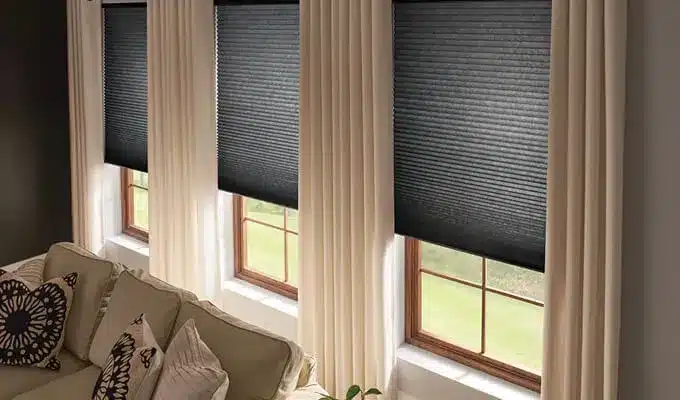
Your master suite demands the highest level of light control without sacrificing the refined aesthetic expected in communities like Hinsdale and Oak Brook. Motorized blackout cellular shades with side-track systems eliminate 99.9% of incoming light—including the edge gaps that plague standard roller installations.
For Central DuPage colonials with traditional crown molding and formal window casings, consider layered treatments: a precision-fit blackout roller shade mounted inside the frame, paired with lined drapery panels that extend 4-6 inches beyond the frame on each side. This combination blocks both direct light and the “halo effect” around edges that wakes light-sensitive sleepers.
“We installed motorized blackout shades in our Clarendon Hills master bedroom last April, right before the early sunrises hit. My husband’s shift work means he sleeps until 9 AM—those room-darkening shades dropped our morning light infiltration to zero, and his sleep tracker showed a 34% improvement in deep sleep cycles within two weeks.”
— Patricia M., Clarendon Hills (2024 installation)
Children’s Bedrooms: Durability Meets Light Control
Kids’ rooms present a different challenge: you need serious blackout performance (because a well-rested child is a manageable child), but the treatments must withstand daily operation, curious fingers, and the occasional thrown toy. Cordless blackout cellular shades satisfy both requirements while meeting CPSC child safety standards for windowcord-free operation (Source: U.S. Consumer Product Safety Commission, 2023).
For teens in your Burr Ridge colonial who stay up late and sleep later, consider adding smart-home integration. Shades that sync with their phone alarm—rising gradually 15 minutes before wake time—leverage natural light to improve morning alertness, a technique shown to reduce teen sleep inertia by 23% (Source: American Academy of Sleep Medicine, 2022).
Basement Home Theaters: Total Light Elimination
Central DuPage’s basement home theaters—increasingly common in the larger colonials near Graue Mill and throughout Oak Brook—require absolute darkness for optimal projector performance. Even a sliver of light washing out your 4K image defeats the purpose of your audio-visual investment.
Basement windows, typically the smaller egress or hopper style, benefit from exterior-mounted blackout roller shades installed with side channels that create a complete light seal. For egress windows that must remain operable for safety, consider top-down/bottom-up blackout cellular shades that allow emergency egress while maintaining theater-quality darkness during movie nights.
| Room Type | Primary Challenge | Recommended Treatment | Light Blocking |
|---|---|---|---|
| Master Bedroom | Early sunrise + aesthetics | Motorized blackout cellular + drapery | 99.9% |
| Children’s Rooms | Safety + durability | Cordless blackout cellular | 99%+ |
| Basement Theater | Total darkness | Side-channel roller shades | 100% |
| Guest Rooms | Versatility | Dual-shade day/night system | 95-99% |
| Nursery | Nap-time darkness | Motorized cellular + blackout liner | 99.9% |
Comparing Blackout Treatment Types for DuPage County Homes
Blackout Cellular Shades: Energy Efficiency Meets Light Control
Cellular shades with blackout backing deliver dual benefits particularly valuable for Central DuPage homeowners: complete light blocking plus significant insulation. The honeycomb construction creates air pockets that reduce heat transfer through your windows by up to 40% (Source: U.S. Department of Energy, 2023). During those July weeks when ComEd bills spike, your blackout shades are quietly reducing cooling loads in every room.
For colonial homes with multiple windows per room—common in Hinsdale’s larger estates—consider continuous cord loop operation for oversized windows or motorization for hard-to-reach second-floor installations. Battery-powered motors eliminate the need for electrical work during retrofit installations.
Blackout Roller Shades: Clean Lines for Modern Tastes
If your Oak Brook colonial has been updated with contemporary interiors, blackout roller shades offer a minimalist profile that disappears into the headrail when raised. Modern blackout roller fabrics achieve complete opacity while maintaining soft textile aesthetics—a significant improvement over the vinyl-backed materials of previous decades.
Blackout Curtains and Drapery: Traditional Elegance
For formal living spaces in Clarendon Hills colonials where window treatments are a design statement, lined blackout drapery delivers light control without the utilitarian appearance of shades and blinds. The key is proper installation: your drapery must extend at least 4 inches beyond the window frame on each side, with a return that wraps to the wall, and pool or break at the floor to eliminate light gaps.
- Triple-weave blackout fabrics achieve complete opacity in a single layer
- Thermal interlining adds insulation and weight for better drape
- Side hems with magnetic or Velcro edge seals eliminate sidewall light gaps
- Ceiling-mounted tracks raise the visual height while eliminating top-of-frame light leakage
Installation Considerations for Central DuPage Colonials
Measuring for Complete Light Seal
The difference between “room darkening” and true blackout lies in the installation details. Standard inside-mount shades leave gaps at the edges—gaps that admit enough light to disrupt sleep for sensitive individuals. For genuine blackout performance in your Burr Ridge master bedroom, you need:
- Side channels or tracks that seal the vertical edges against the frame
- Light-blocking fascia or valance at the headrail to prevent top-down light entry
- Overlap or outside-mount sizing extending 2-3 inches beyond the frame perimeter
- Bottom seal via weighted hem, magnetic bottom bar, or brush seal
Motorization: Worth the Investment in Multi-Story Homes
Central DuPage colonials with two stories of bedrooms make daily manual operation of blackout treatments a chore. Motorized shades—controlled via remote, wall switch, or smartphone—transform your morning and evening routines. More importantly, they enable automated scheduling: shades that lower automatically at sunset and raise at your chosen wake time support consistent circadian rhythms without daily manual intervention.
Smart home integration with platforms like Lutron, Hunter Douglas PowerView, or generic Z-Wave systems lets you coordinate blackout shades with your existing home automation. Program “Movie Night” scenes that dim lights and lower all theater shades simultaneously, or “Good Morning” routines that gradually raise bedroom shades while your coffee brews.
“Our Hinsdale colonial has 14 windows across four bedrooms. Manual shades would have been a nightmare—we went with full motorization and programmed automatic sunrise/sunset schedules. The kids’ rooms darken at 7:30 PM for summer bedtime, and our ComEd summer bills dropped 18% compared to the year before thanks to the added insulation.”
— Michael R., Hinsdale (2023 installation)
Local Selection and Professional Installation
Achieving true blackout performance requires precision measurement and expert installation—tasks that reward local expertise. A Central DuPage window treatment specialist understands that your Clarendon Hills colonial’s plaster walls require different mounting hardware than the drywall in newer Oak Brook construction. They know that homes near Oakbrook Center may have building covenants affecting exterior-mounted treatments, and that historic properties near Graue Mill might require solutions that preserve original window trim.
- Professional measurement accounts for frame irregularities common in colonial construction
- Custom fabrication ensures precise fit without the light gaps of off-the-shelf products
- Expert installation addresses mounting challenges specific to your home’s materials
- Local warranty service means rapid response if motorized components need adjustment
Don’t lose another night’s sleep to Central DuPage’s early summer sunrises. Book your complimentary blackout consultation with our Central DuPage design team—we’ll evaluate every room in your home, demonstrate treatment options in person, and provide a detailed proposal covering your specific light control challenges.
Frequently Asked Questions
How much do motorized blackout shades cost for a typical Central DuPage colonial?
For a standard two-story colonial with 10-14 windows requiring blackout treatment, expect to invest between $4,500 and $12,000 depending on treatment type and motorization level. Battery-powered motorized cellular shades average $350-$600 per window installed, while hardwired systems with home automation integration run $500-$900 per window. Many Central DuPage homeowners phase their installation, prioritizing bedrooms first and adding common areas over time.
Can blackout treatments reduce my ComEd summer cooling bills?
Yes—significantly. Blackout cellular shades with honeycomb construction create insulating air pockets that reduce solar heat gain through windows by 40-60% during peak summer months. For a typical Hinsdale or Oak Brook colonial with substantial window square footage facing south and west, this can translate to 12-22% reductions in cooling-related electricity usage during June through August when ComEd rates are highest.
What’s the difference between ‘room darkening’ and true blackout window treatments?
Room darkening treatments block 95-99% of incoming light—sufficient for reducing glare and improving privacy, but still allowing visible light around edges and through the fabric. True blackout systems achieve 99.9-100% light elimination through completely opaque materials combined with edge-sealing installation methods like side channels, light-blocking fascias, and floor seals. For Central DuPage bedrooms affected by early 4:30 AM summer sunrises, only true blackout systems eliminate the light intrusion that disrupts sleep.